Quick answer: What to do when your dog dies: stay with them if you can, move them gently onto a blanket in a cool spot, and call your vet, who can arrange cremation and advise on burial. In warm weather, call sooner. Take your time, and lean on someone for support.
We're so sorry you're here. This guide walks through the practical steps first, then your options for cremation and burial, then grief and who to talk to. If you're also thinking about keepsakes, our pet urns guide is there when you're ready, and not before.
What should you do in the first hours after your dog dies at home?
Take a few quiet minutes with your dog. Then lay them gently on a blanket or towel in a cool spot, close their eyes if they're open, and call your vet, or an emergency clinic after hours, to ask about collection or cremation. Nothing has to be decided in the first few minutes.
Lap of Love, a US veterinary hospice network, lists the signs of death as no breathing or chest movement, no heartbeat and fixed pupils. It says the body may release urine, stool or air as it relaxes, and that the body stiffens as it cools (Lap of Love). None of that means your dog is in distress. A towel under their back end can help with any mess.
| When | What to do |
|---|---|
| Straight away | Check for breathing, a heartbeat and pupil response. If you aren't sure, call your vet and they can talk you through it. |
| First hour | Move your dog onto a blanket or towel in a cool spot, and close their eyes if they're open. Let family say goodbye in their own time. |
| Same day | Call your vet about cremation, collection or storage. Decide about burial or cremation, and check your council's rules if you're thinking of a home burial. |
| Within 12 to 24 hours | Lap of Love suggests arranging cremation or burial within this window, with up to about 24 hours at home in cool weather. |
| In hot weather | Call the vet sooner. Lap of Love says a wrapped ice pack may be needed in warm climates, and that the time at home is shorter. Our summers can be hot indoors too, so keep your dog in the coolest room. |
What will your vet do?
Your vet can arrange for your dog's body to be cared for, and many clinics offer cremation. Cremation isn't always available, so ask what your clinic offers. If your dog died at home, ask whether they can collect or store the body, or whether you should bring your dog in.
RSPCA Queensland says your vet can arrange disposal and that many vets offer cremation, shared with other animals or individual (RSPCA Queensland, 4 July 2022). If your dog was euthanased at the clinic, the staff will usually talk you through your choices there. It's fine to ask questions, take a moment, or say you aren't ready to decide.
Private or communal cremation: what's the difference?
Communal cremation means your dog is cremated together with other animals, so you don't receive your own dog's ashes. Individual (private) cremation means your dog is cremated alone, so any ashes returned are your dog's. Only individual cremation returns your own pet's ashes.
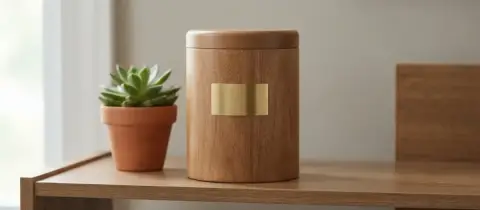
RSPCA Queensland describes vets offering cremation either with other animals or individually. Ask your vet or the crematorium exactly how the ashes come back, and what you can include with your dog. If you do choose individual cremation, an urn is a common next step. As a rule of thumb, ICCFA (a cemetery and cremation association) suggests one cubic inch of urn per pound of your pet's weight (ICCFA, page read 21 November 2026), which works out at about 36 ml of urn per kg. Many families go bigger to fit a collar or toy. Our pet urns guide has a size table by weight in kg.
Cremation also suits you if you rent or plan to move, because the ashes can come with you. RSPCA Queensland notes that burial may not suit people who expect to move, as you'd leave your dog behind.
Can you bury your dog in the backyard in Australia?
Sometimes, but it depends on where you live. Rules differ between councils and states, so check your own council before you dig. Walkerville Vet advises a grave at least 1 m deep, in an ornamental part of the garden, and extra care is needed if your dog was put to sleep.
RSPCA Queensland says some areas don't allow burial on private property, because of factors like the cause of death, the water table or soil type. As one council's example only, Toowoomba Regional Council lists a minimum burial depth of 60 cm for a dog or cat (Toowoomba Regional Council, page read 21 November 2026). Your council may say something different, and some accept animals at council waste facilities, often with fees and strict requirements, so ring before you go.
If your council allows it, Dr Andrew Spanner of Walkerville Vet in Adelaide suggests:
- digging at least 1 m deep, away from power and water lines and any future building plans
- choosing an ornamental garden bed, not anywhere you grow food
- wrapping your dog in natural fabric such as a cotton pillowcase or woollen blanket, not a plastic bag
- keeping other pets away during the burial, and tamping the soil down as you fill the hole
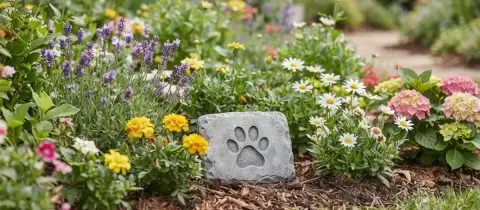
- marking the grave with a slab or stones
(Walkerville Vet, posted 20 March 2019, updated 11 August 2023). He advises against home burial if your dog died of a contagious disease such as parvovirus.
Why a euthanased dog needs extra thought: the euthanasia drug, pentobarbitone, can persist in the ground. Rachel Allavena, a veterinary pathologist at the University of Queensland, writes that the drug can stay in a buried body for up to a year, and that animals who dig up and eat the remains can be poisoned. She describes a family terrier made critically ill this way, and suggests putting the body where other animals can't reach it (The Conversation, 2019, read via Phys.org). So if your dog was euthanased, ask your vet about a burial box, or about cremation instead. For a marker, see our pet memorial stones guide.
Your options compared
Most people choose between vet-arranged cremation (communal or individual) and a home burial. Pet cemeteries and council waste facilities are other routes. The right one depends on whether you want your dog's ashes, whether you rent or may move, and how your dog died.
| Option | What happens | Your dog's own ashes? | Best for | Check first |
|---|---|---|---|---|
| Communal cremation (via your vet) | Cremated together with other animals | No | Someone who doesn't want ashes | Ask your vet what they offer |
| Individual (private) cremation | Cremated alone | Yes | Keeping ashes, renters, people who may move | How the ashes are returned |
| Home burial | Buried on your property | Not applicable | Homeowners with a suitable garden | Council rules, pipes and cables, cause of death, whether euthanasia drugs were used, whether you may move |
| Pet cemetery | Burial in a dedicated place | Not applicable | A place to visit without a garden grave | What your local options are and what they require |
| Council waste facility | Accepted at some council sites | Not applicable | When other options aren't available | Whether your council accepts animals, fees and requirements |
What if your cat dies?
The same steps apply: a blanket, a cool spot, a call to your vet, and the same cremation and burial choices. The council and euthanasia-drug points matter just as much for cats. Cats Protection warns that many essential oils, including lavender and eucalyptus, are toxic to cats (Cats Protection, 14 April 2021), so skip essential oil diffusers and oil burners in a home where other cats live.
Our pet urns guide covers cat-sized urns, and a paw print kit works with cats too, with an ink pad the easiest option. If you have other pets, watch how they go in the following days, and call your vet if they stop eating or seem unwell.
How do you cope with the grief, and who can you talk to?
Talk to someone. A friend who knew your dog, Griefline, your GP or a grief counsellor can all help, and Lifeline is there if things feel too heavy. Give yourself time. There's no set timeline for grief, and no right moment to think about another dog.
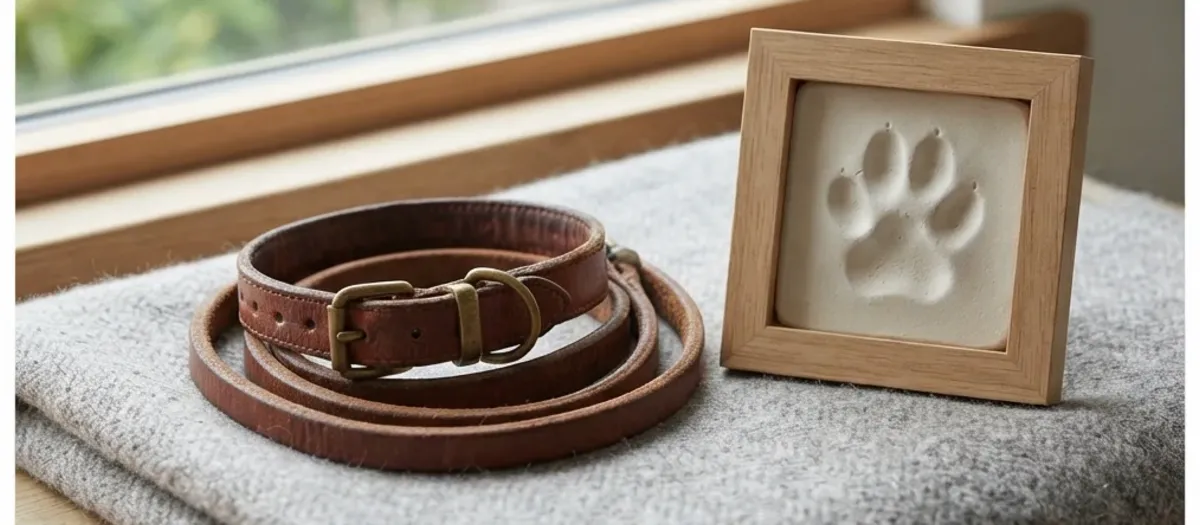
Griefline's page on losing a pet says guilt about end-of-life decisions, including euthanasia, is a normal part of grief, and that the empty spots in your routine, like walks and daily habits, can hurt. Keeping a memory box with the collar, tag or a favourite toy is one gentle way to remember (Griefline, published 5 June 2025).
Who to call
- Griefline: 1300 845 745 (check griefline.org.au for current hours)
- Lifeline: 13 11 14 for 24-hour crisis support, or text 0477 13 11 14. Lifeline isn't a pet loss service, but it's there if things feel too heavy (Lifeline, page read 21 November 2026)
- Triple Zero (000) if someone's life is in danger
- Your GP, who can point you to a counsellor
Telling children: Griefline notes that a pet's death is often a child's first experience of death. You might say, "Our dog died. Her body stopped working and she can't come back." A drawing, or a flower planted in your dog's memory, gives them something to do with their feelings.
Useful guides
When you feel ready, these guides cover the practical keepsakes. There's no rush for any of them.
- Pet urns: what size you need by weight, for cats through to large dogs.
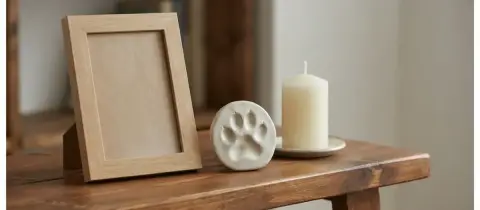
- Paw print kits: clay and ink kits. Ink is the quickest and gentlest option soon after a death, and you can ask your vet for help.
- Pet memorial stones: garden markers, plaques and stakes for a grave or a memory garden.
- Pet memorial gifts: frames and keepsakes, including ideas for a friend whose dog or cat has died.
When to call your vet
Call your vet if:
- The death was sudden or unexplained. Other pets may have had the same exposure, such as a toxin, a snake or a paralysis tick.
- You think a poison was involved. Call your vet or the Animal Poisons Helpline (1300 869 738, 24/7) about the other pets in the house.
- Another pet stops eating, vomits or seems unwell
- You'd like to ask about a vet school donation
- You need your dog's body collected or stored
If you're struggling, see Griefline's page on losing a pet and the support numbers above.
Frequently asked questions
How long can a dog's body stay at home before burial or cremation?
In cool weather, Lap of Love says up to about 24 hours, and it suggests arranging cremation or burial within 12 to 24 hours. In warm weather it's less, so keep your dog in the coolest room, use a wrapped ice pack and call your vet early.
Can I bury my dog in the backyard if I'm renting?
Probably not without checking. Ask your landlord, and check your council's rules, since some areas don't allow burial on private property. RSPCA Queensland notes that burial may not suit you if you plan to move. Cremation lets you take your dog's ashes with you.
Why does it matter for burial if my dog was put to sleep?
The euthanasia drug, pentobarbitone, can persist in a buried body and in the soil. A UQ veterinary pathologist says animals that dig up the remains can be poisoned. If your dog was euthanased, ask your vet about a burial box or about cremation, and keep the grave away from food crops.
How do I tell my child that our dog has died?
Be honest and use plain words, such as "died" and "can't come back". Griefline advises avoiding "went to sleep" or "ran away", which can confuse children. Let them ask questions, cry and say goodbye in their own way, and let them help choose a way to remember your dog.
Is it normal to grieve this much for a dog?
Yes. Griefline says losing a pet can feel like losing a close friend or family member, and that the grief is valid. Guilt, loneliness and a disrupted routine are common. If it feels too heavy, talk to a friend, Griefline, your GP or a grief counsellor.
Can I donate my dog's body to a vet school?
Sometimes. A UQ veterinary pathologist notes that donating your dog's body to a vet school is an option, and that it helps with research and teaching. Your vet can point you to local options. Ask early, as it needs arranging before burial or cremation.
What should I do if my dog dies after hours?
Move your dog onto a blanket in a cool spot, then call your usual vet, whose message may point you to an after-hours clinic. Lap of Love says to contact your nearest emergency vet centre after hours. If it's warm, use a wrapped ice pack and ask the clinic about collection.
Related guides
- Pet urns: what size you need by weight
- Paw print kits
- Pet memorial stones and garden plaques
- Pet memorial gifts
- Paralysis tick in dogs and cats
- All our dog guides
Sources
- Lap of Love, What Happens If My Pet Passes Away at Home Before Euthanasia?, page read 21 November 2026 (https://www.lapoflove.com/blog/end-of-life-care-and-euthanasia/what-to-do-if-pet-passes-away-home-before-euthanasia)
- RSPCA Queensland, What to do when your pet passes away, 4 July 2022, page read 21 November 2026 (https://www.rspcaqld.org.au/blog/in-the-community/what-to-do-when-your-pet-passes-away)
- Toowoomba Regional Council, Removal and disposal of deceased animals, page read 21 November 2026 (https://www.tr.qld.gov.au/Animals/Removal-and-disposal-of-deceased-animals)
- Walkerville Vet, Can I Bury My Dog Or Cat At Home? posted 20 March 2019, updated 11 August 2023, page read 21 November 2026 (https://www.walkervillevet.com.au/blog/dog-cat-bury-at-home/)
- Rachel Allavena, Why you shouldn't bury your pet in the backyard, The Conversation, 2019, read via Phys.org, 18 March 2019 (https://phys.org/news/2019-03-shouldnt-pet-backyard.html)
- Griefline, Losing a pet, published 5 June 2025, page read 21 November 2026 (https://griefline.org.au/resources/losing-a-pet/)
- Lifeline, page read 21 November 2026 (https://www.lifeline.org.au/)
- ICCFA, What size urn do I need? page read 21 November 2026 (https://iccfa.com/faq-items/what-size-urn-do-i-need/)
- Cats Protection, Are essential oils dangerous to cats?, 14 April 2021, page read 21 November 2026 (https://www.cats.org.uk/cats-blog/cats-and-essential-oils)
This guide provides general information and isn't a substitute for veterinary advice. If you're concerned about your dog's death or the health of your other pets, speak with your vet.